
The legal profession is changing. AI is reshaping how law firms operate, serve clients, and manage day-to-day work—and most firms are paying attention. From contract drafting to legal research, AI is becoming a normal part of how legal teams get work done.
Lawyers are using it to get through routine, time-consuming tasks faster, so they can focus on the work that actually requires their judgment. Used well, AI doesn't replace what lawyers do. It gives them more room to do it better.
This blog looks at the best AI tools for law firms in 2025, breaking down their core functions, practical applications and how they work with human support like virtual legal assistants. Whether you’re a solo practitioner or managing a large legal department, these tools are worth knowing about.
AI Adoption

Recent surveys indicate that AI adoption in the workplace is growing rapidly, with estimates showing 20–40% of workers and firms using AI, though rates vary depending on methodology, weighting, and whether surveys focus on generative AI specifically.
Firm-level surveys, including the U.S. Census Bureau BTOS and various Federal Reserve and professional association studies, suggest adoption is higher in larger firms and for employment-weighted estimates, while worker-level surveys show high uptake.
As these tools become more reliable and accessible, law firms are moving from experimentation to practical implementation.
Benefits of Legal AI Tools for Lawyers
AI tools for lawyers are no longer limited to experimental use. Law firms now rely on them to manage legal documents, extract key details, and automate legal tasks that once required hours of human labor.
Key benefits of AI-powered tools in the legal field include:
- Accelerating case law research and legal document review
- Enhancing the accuracy of contract analysis and due diligence
- Automating legal document creation and formatting
- Assisting attorneys in identifying legal issues faster
- Supporting legal departments with scalable AI solutions
- Producing higher quality work product by identifying errors and missing clauses in documents
- Summarizing lengthy legal documents to reveal key points using tools like CoCounsel
With natural language processing and machine learning embedded into legal tools, law firms can now access contextual legal information quickly and efficiently. AI can save lawyers significant amounts of time by processing large volumes of information rapidly.
Core Use Cases for AI in Legal Practice
AI is being used across a wide range of legal tasks across practices of all sizes and areas. These are the areas where it's making the most practical difference right now.
- Legal Research: AI solutions help legal professionals find case outcomes, legal information, and interpretations faster. Legal teams no longer spend hours navigating databases manually. AI can be trained to recognize specific legal language and terms, which enhances its effectiveness.
- Contract Analysis: With contract analysis tools, legal departments can assess contracts for compliance, extract key clauses and obligations, and receive actionable insights that can lead to better legal strategies.
- Legal Document Creation: Rather than starting from scratch, AI tools can generate a working first draft based on the document type and key inputs. It won't replace the attorney's judgment on the final version, but it removes a lot of the blank-page work upfront.
- Document Review: AI-powered document review systems help identify inconsistencies, reduce human error, and accelerate response times. These tools improve workflow efficiency and provide consistent results.
- Compare Documents: AI tools can compare documents, spot subtle changes, and highlight discrepancies across contract versions or filings.
Top Legal AI Tools for Law Firms
Case Law Research
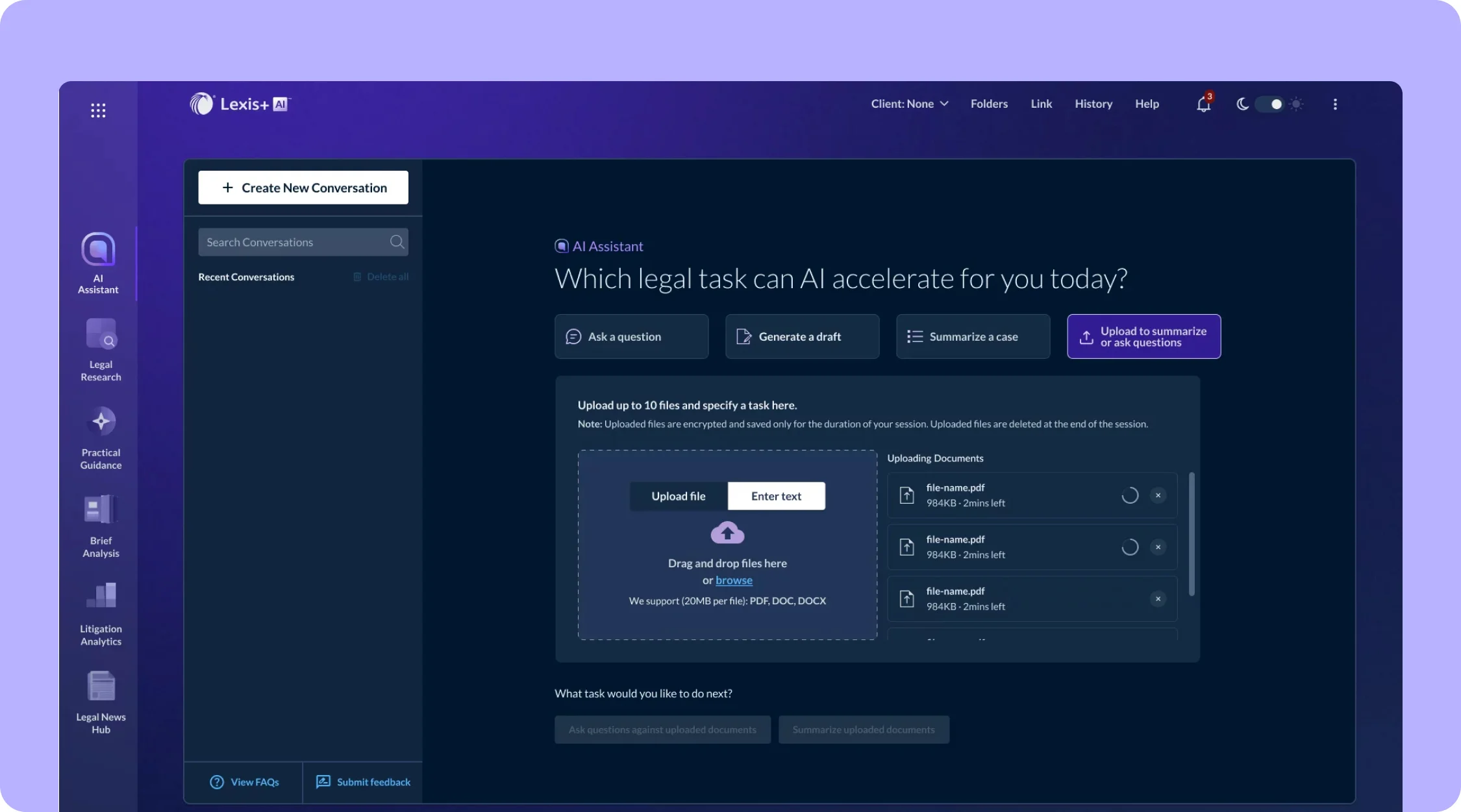
Lexis+ AI uses natural language processing to surface relevant case law with deep contextual understanding. It improves legal research by offering predictive insights, legal reasoning, and visual case mapping. Lexis+ AI provides an intuitive interface for legal professionals to input complex legal questions and receive relevant answers.
Contract Review
LawGeex supports legal teams with automated contract analysis. It reviews contracts against pre-approved standards, flags risky language, and helps compare documents for consistency. Legal AI tools like LawGeex are designed to improve accuracy in the review process by identifying potential errors or missing provisions in documents.
Drafting and Summarizing
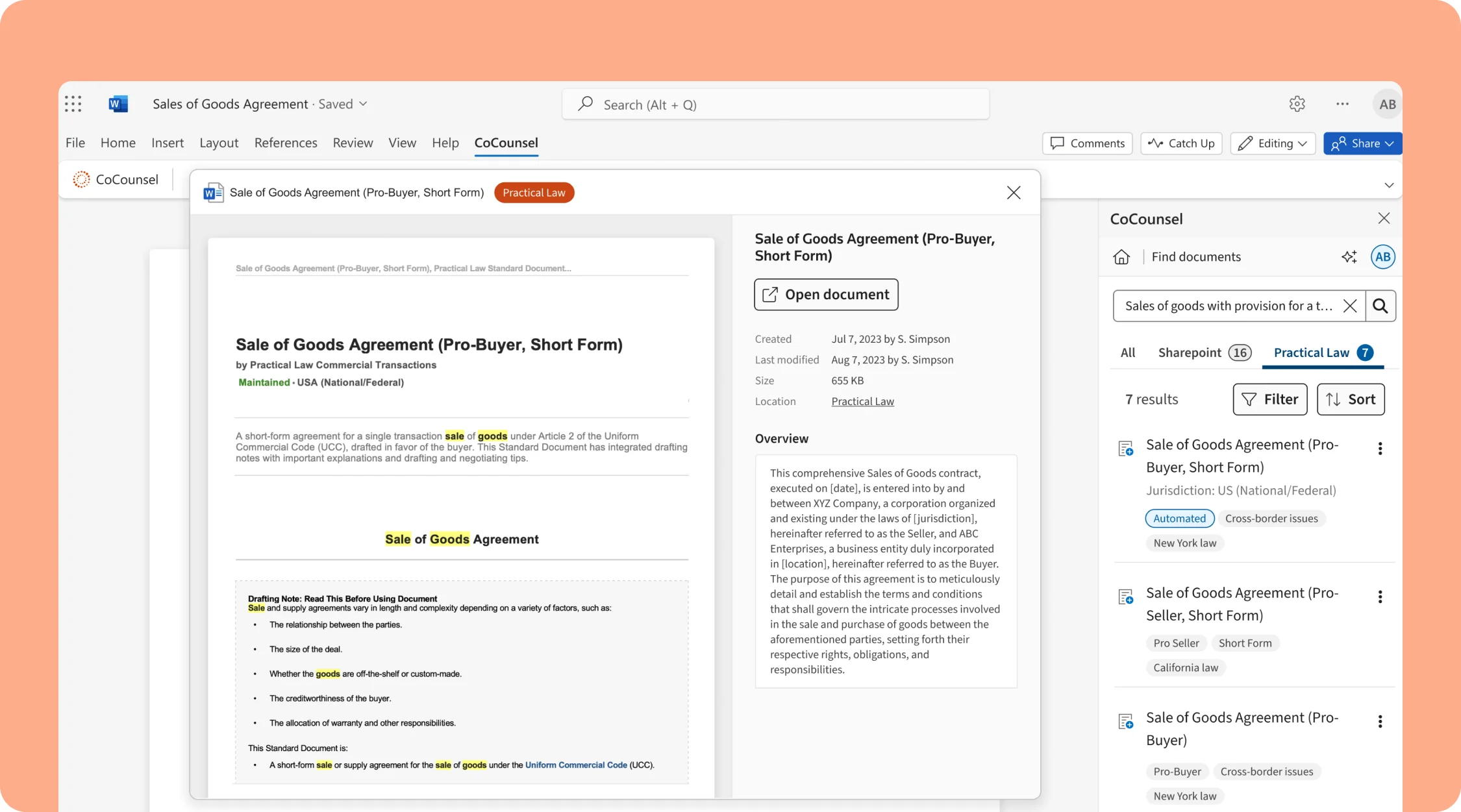
CoCounsel uses large language models to assist attorneys in generating legal content. It can draft documents, summarize legal data, and perform due diligence reviews with speed and precision. CoCounsel helps attorneys automate the review of documents quickly and accurately and creates timelines of events within contracts.
Document Review and Due Diligence
Luminance specializes in reviewing complex documents and identifying key documents for M&A, regulatory compliance, and investigations. It reads and categorizes large document sets quickly and surfaces the ones that actually need attention. It works best for larger firms and legal departments handling enterprise-level deals.
Diligen takes a more targeted approach, helping legal teams search contracts for specific clauses and provisions. If you need to know whether a particular indemnification clause appears across 200 contracts, Diligen can do that work in a fraction of the time it would take manually. Practical for firms doing portfolio-level contract analysis.
Case Intelligence
Darrow uses generative AI to analyze public data for potential legal violations. It is useful for litigation funding and plaintiff-side firms looking to identify viable cases before a client even walks in the door. Darrow is a different kind of tool than most on this list, more about case sourcing than case execution.
Ethical and Practical Considerations for Legal AI Tools
Choosing the right AI tool requires understanding your firm's specific needs. A few factors worth evaluating before committing to a platform:
- Security protocols: Make sure the vendor is clear about how your data is stored, who can access it, and what safeguards are in place—legal data is sensitive and deserves more than a generic privacy policy.
- User-friendliness: A tool that's difficult to use won't get used consistently, so it's worth testing how much setup and training your team would actually need.
- Integration capabilities: Check whether the tool connects with your existing case management or document systems, because a platform that creates extra manual steps can slow things down rather than help.
- Vendor reputation: Look for established track records, client reviews, and transparency about how the tool was built and how it handles errors.
- Verifiable and authoritative sources: Any tool used for legal research or document analysis should be able to show its work—outputs that can't be traced back to a source aren't reliable enough for legal use.
Beyond the practical side, there are real ethical obligations to keep in mind. The ABA's Formal Opinion 512 makes clear that lawyers using generative AI must fully consider their ethical duties. This includes providing competent representation, protecting client information, maintaining clear communication with clients, and charging fees that accurately reflect the time spent—even when AI did part of the work.
AI tools can produce confident-sounding output that's wrong. Attorneys are responsible for what goes out under their name regardless of how it was generated, and the duty to supervise extends to AI just as it does to paralegals and nonlawyer staff. Used carefully, these tools are genuinely useful. Used carelessly, they create liability.
What Legal AI Can't Replace: Human Expertise
While AI can automate everyday tasks and enhance law firm operations, it cannot replace the human expertise needed for strategic decision-making, ethical considerations, and nuanced client service.
Tasks requiring judgment, client trust, and emotional intelligence—such as negotiations or case strategy—still fall under the purview of lawyers. By automating routine tasks, AI allows lawyers to focus more on substantive legal work, which enhances client engagement.
This is why pairing AI tools with human support, like virtual legal assistants from Legal Soft, creates a balanced solution that meets the needs of both clients and attorneys.

How Virtual Legal Assistants Complement AI Tools
Virtual legal assistants are trained to support legal teams with:
- Client intake and appointment scheduling
- Legal document formatting and editing
- Case management and follow-ups
- Coordination with courts and external stakeholders
By handling routine tasks, virtual assistants enable attorneys to focus on higher-level legal work while ensuring that AI tools operate effectively in a real-world legal setting. Many legal professionals report that AI tools help them to achieve more effective and efficient case management.
Combine AI Tools and Human Support for Best Results
The best AI tool for your firm depends on what's actually slowing you down. If legal research is the bottleneck, Lexis+ AI is worth a close look. If you're processing a lot of contracts, LawGeex or Diligen will save more time than a general-purpose tool. For document-heavy M&A or compliance work, Luminance is built for that. For drafting and summarizing across practice areas, CoCounsel is the most versatile option on this list.
No tool replaces attorney judgment, and none of them work well without someone accountable for the output. But the right combination of AI tools and human support can make a real difference in how much your team can handle — and how well they handle it.
If you're looking to pair AI tools with trained human support, Legal Soft provides virtual legal assistants experienced in U.S. legal workflows, available to work alongside whatever platforms your firm is already using.